
Every two years, the fee schedule revision has imposed a large workload on medical institutions and system vendors. In the short window between publication of the notices and the effective date, vendors overhaul EMRs and rececons nationwide all at once, while institutions scramble to apply and verify them. This cycle had become a bottleneck for advancing Medical DX. "Fee Revision DX" is an effort to rebuild that structure itself. This article organizes what it involves and how it affects clinics.
Disclaimer: This article is general information. The content of revisions, effective dates, and the treatment of system support may change through notices. In practice, always confirm the latest primary sources (MHLW, Regional Bureaus of Health and Welfare, the Social Insurance Medical Fee Payment Fund, and others).
For the overall map of Medical DX, see What Is Medical DX? The Government Roadmap and Its Three Pillars.
Why Fee Revision DX Emerged
Under the conventional approach, burdens piled up all at once:
- On vendors: overhaul every product in a short period and distribute and apply it to sites nationwide. Staff are pinned to revision work and other development stops
- On institutions: understand the revision, accept system updates, file facility standard notifications, and disseminate billing rules—all in parallel
- As a result: billing errors and returned claims increase right after a revision, and vendors' modification costs are ultimately passed on to institutions
The government's "Roadmap for Promoting Medical DX" positioned reducing this burden as one of the three pillars of Medical DX. What sets it apart from other Medical DX measures is that it is not a measure requiring institutions to adopt something new, but one that rebuilds the revision mechanism itself.
Over the medium to long term, the largest value Medical DX brings is that the burden of developing medical information systems falls, creating an environment where old systems turn over more readily. Of the burdens vendors have carried, Fee Revision DX takes on the left-hand side of the figure below.
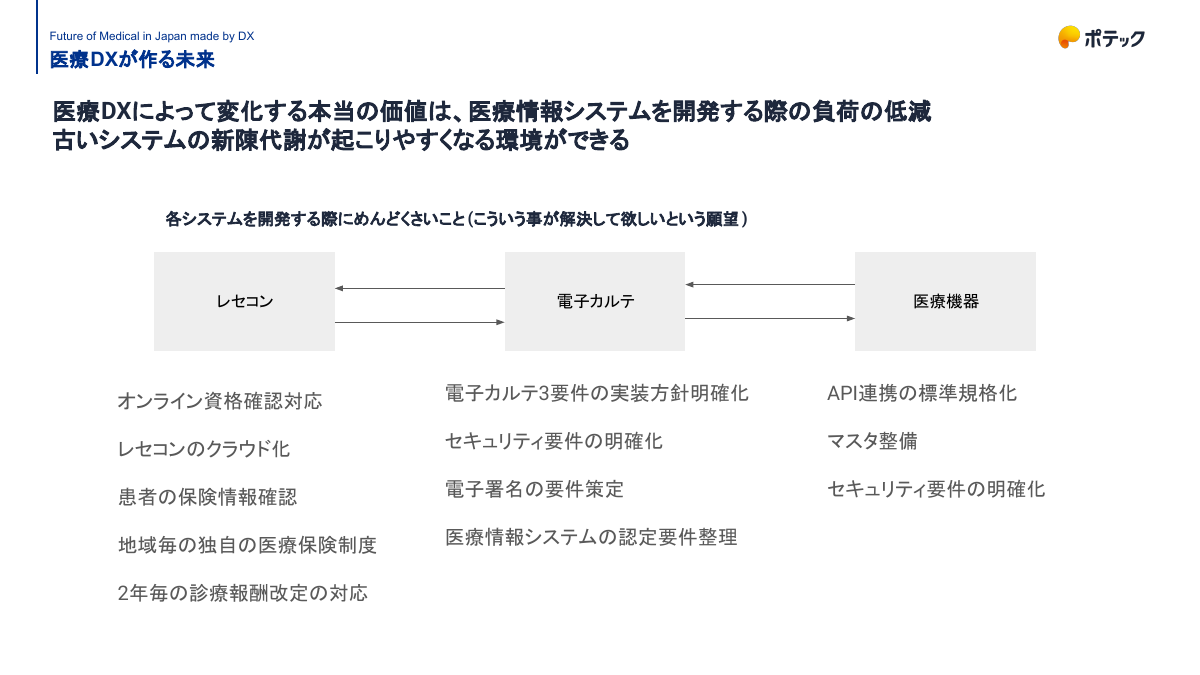
The Three Pillars
1. Postponing the Effective Date
The clearest change is the revised timing. Previously both drug prices and the main body took effect on April 1; from the FY2024 revision, the main body moved to June 1.
| Category | Effective date in the FY2026 revision |
|---|---|
| Drug price revision | April 1, 2026 |
| Main body (basic consultation fees, admission fees, additions, etc.) | June 1, 2026 |
With roughly two additional months between publication and the effective date, vendors gain time for modification and testing, and institutions gain room to consider facility standards and file notifications. On the other hand, a period arises in which the rules applied in April differ from those in June, so the fiscal-year transition actually demands more care. That drug prices alone move in April is especially easy to overlook at clinics that dispense in-house.
2. The Common Billing Module
A nationwide common program that calculates fees and patient copayments. Billing logic that each vendor previously implemented separately is unified; at revision time, the Payment Fund modifies the module and masters, greatly narrowing each vendor's scope of work.
For medical and DPC, full operation began on June 1, 2026, and it became usable on rececons provided by ORCA. For details, see the explainer on the common billing module.
3. Common Masters and Codes
Even where standardized masters for drugs, procedures, and diagnoses were provided, implementation details varied by vendor. Unifying them reduces the scope of modification at revision time and lays the groundwork for data linkage across institutions. Because sharing data on the National Medical Information Platform (pillar ①) presupposes aligned code systems, this work is also foundational to information sharing.
Impact on Clinics
Short Term: The Schedule Changes
The first thing to grasp is that the rhythm of revision work has changed.
- March–April: respond to the drug price revision; update stock and prices if you dispense in-house
- April–May: review the main body's content, consider facility standards, prepare notifications
- June 1: the main body takes effect; switch billing rules
If you keep the old "everything moves in April" instinct, you risk misreading notification deadlines. In revision years, check the Regional Bureau's published notification schedule early.
Medium Term: More Criteria for System Selection
The common billing module and common masters are not things institutions adopt directly. But they matter as criteria when choosing a rececon or EMR. Points worth confirming:
- Whether there is a policy to support the common billing module
- Whether revision support is included in maintenance fees or incurs additional charges each time
- Whether system updates at revision time require in-house work or are completed on the service side
With cloud services, revision handling increasingly completes on the vendor side, leaving institutions only to verify the results. If you are on-premises and incur modification fees each time, the per-revision cost is likely to become relatively expensive going forward.
Long Term: The Cost Structure Shifts
Fee Revision DX aims to lower the whole-of-society cost of handling revisions. As this progresses, we can expect compression of the costs previously passed on to institutions via vendors' modification work. Conversely, products that do not ride on the unified mechanism will keep bearing the cost of independent modification. Compare products not only on "current features" but on "what happens at each revision."
Common Misunderstandings
It does not mean revision work disappears
The common billing module handles fee calculation and copayment calculation. It does not eliminate the institution's own work—filing facility standards, understanding billing requirements, and changing in-house operations.
A June effective date does not mean April is quiet
The drug price revision takes effect on April 1. Transitional measures and notification deadlines are also set separately from the main body's effective date, so spring in a revision year remains as busy as ever.
With AI Karte
The AI-native EMR "AI Karte" is a cloud service with an integrated rececon, and fee schedule revisions are handled on the service side. Reflecting revision content requires no separate in-house update work; the premise is that the switch happens in line with the effective date. AI claim checking additionally helps detect the billing errors that tend to occur right after a revision.
Conclusion
Fee Revision DX is not a measure requiring institutions to adopt something new; it reduces the burden inherent in the revision mechanism itself. For clinics, it comes down to two points: (1) the schedule shift to drug prices in April and the main body in June, and (2) confirming the method and cost of revision handling when selecting a rececon or EMR. Revisions will keep coming. It is time to re-evaluate systems based on what happens each time one does.
Through providing AI Karte, Pottech aims to be the ideal business partner for clinics—improving the working environment for physicians, nurses, and medical clerical staff, and supporting clinics in fully realizing what they want to achieve.
For more details, please feel free to contact us.