
The term "Medical DX" has become part of everyday vocabulary, but with individual measure names appearing one after another—electronic prescriptions, the Myna insurance card, the standard EMR, the common billing module, PMH—many clinic directors find the overall picture hard to grasp. These are not scattered initiatives: they all sit on a single blueprint, the government's "Roadmap for Promoting Medical DX." This article organizes that overall picture and its three pillars, and summarizes from a practical standpoint what clinics should prepare for and when.
Disclaimer: This article is general information. The content of the roadmap, the timing of each measure, and their treatment under the fee schedule may change through revisions and notices. In practice, always confirm the latest primary sources (official materials from the Cabinet Secretariat, MHLW, the Digital Agency, the Social Insurance Medical Fee Payment Fund, and others).
What Medical DX Refers To
Medical DX refers to a set of initiatives that share and utilize information arising at each stage of health, medical, and long-term care through an optimized common foundation, thereby improving public health and streamlining operations at medical institutions. It is not merely "replacing paper with digital"; its essence is making information that has been siloed within individual institutions shareable with the right party at the right time.
As for the promotion structure, a "Medical DX Promotion Headquarters" headed by the Prime Minister was established within the government, and the "Roadmap for Promoting Medical DX" was compiled in 2023. Multiple organizations—MHLW, the Digital Agency, the Children and Families Agency, and the Social Insurance Medical Fee Payment Fund—divide the roles and drive implementation.
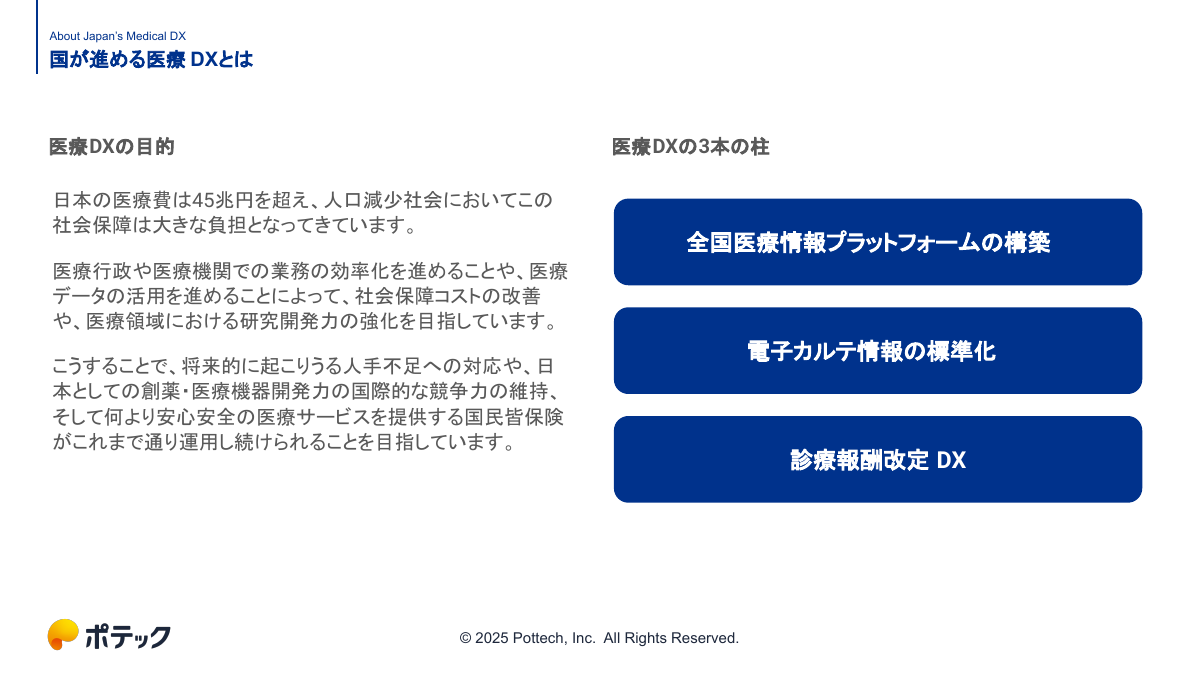
Behind it lies the sustainability of social security. Japan's health expenditure exceeds 45 trillion yen, and in a shrinking population this burden grows. Improving efficiency in health administration and at institutions, and advancing use of medical data, aims to improve social security costs and strengthen R&D capacity in healthcare. Responding to future workforce shortages, maintaining international competitiveness in drug and device development, and above all keeping universal health insurance operating as it has are the ultimate goals.
The Three Pillars of Medical DX
The roadmap is broadly composed of the following three pillars. Every individual measure ties into one of them.
| Pillar | Content | Main measures |
|---|---|---|
| ① Building the National Medical Information Platform | Create a nationwide foundation for sharing information among institutions, municipalities, and patients | Myna insurance card / online eligibility verification, electronic prescriptions, the EMR Information Sharing Service, PMH, the long-term care information infrastructure |
| ② Standardizing EMR information, etc. | Align data into a shareable format and promote EMR adoption itself | Standardization of EMR information (HL7 FHIR), the standard EMR |
| ③ Fee Revision DX | Structurally reduce the burden on vendors and institutions that arises with every revision | The common billing module, common masters and codes, postponing the revision's effective date |
It becomes easier to understand if you frame ① as "connecting," ② as "aligning," and ③ as "reducing the burden of revisions."
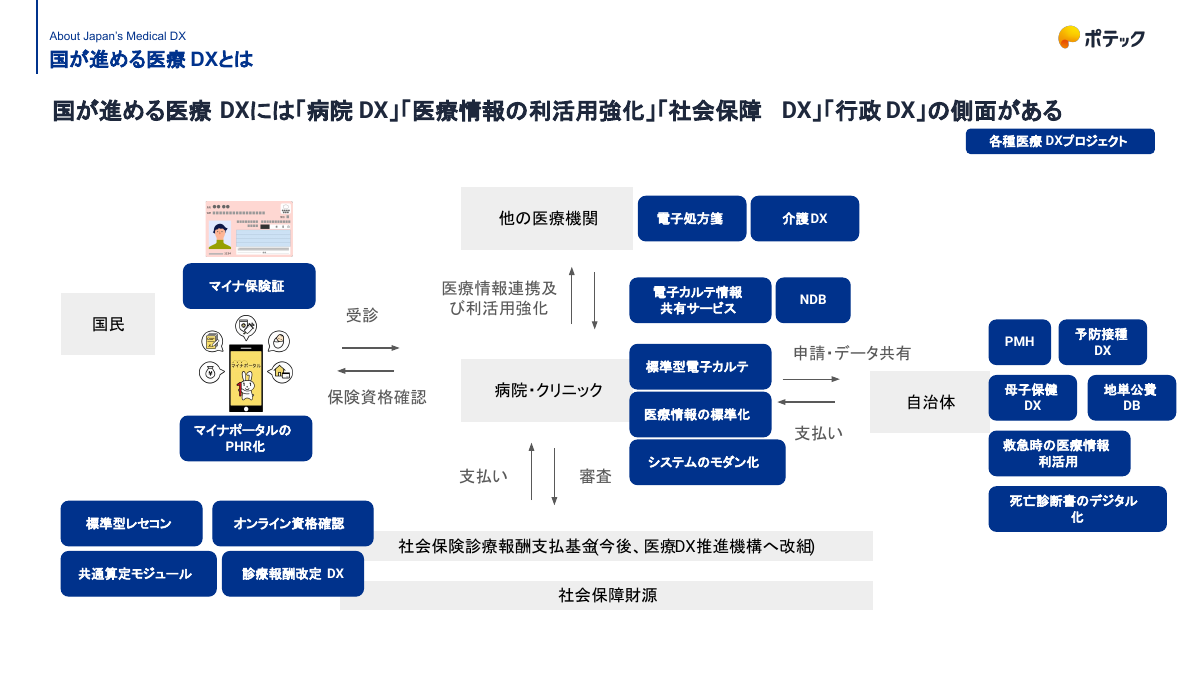
Another Lens: The Four Faces of Medical DX
The three pillars organize "what the government builds"—the supply side. To judge the impact on your own clinic, it helps to split by "what changes."
| Face | What changes | Main measures |
|---|---|---|
| Hospital DX | Work and systems inside institutions | Standard EMR, system modernization, standardizing medical information |
| Stronger data utilization | Cross-institution linkage and secondary use | EMR Information Sharing Service, electronic prescriptions, NDB |
| Social security DX | Eligibility verification, claiming, and review | Myna insurance card, online eligibility verification, common billing module |
| Administrative DX | Procedures for municipality-run programs | PMH, Vaccine DX, Maternal and Child Health DX, local funding DB |
Social security DX ties directly to fees; hospital DX changes daily work; administrative DX affects front-desk work in pediatrics and obstetrics. See What Is Social Security DX? for the first of these.
Measures and Current Status by Pillar
① The National Medical Information Platform
A foundation that allows information to be referenced across institutions with the patient's consent. Some parts are already running; others are still spreading.
- Myna insurance card / online eligibility verification: New issuance of the conventional health insurance certificate has ended, and the system has shifted to one based on the Myna insurance card. Utilization has risen to nearly 70% nationwide (about 68% as of April 2026). On the fee schedule side, this utilization rate is built into facility standards (raised in stages under the former medical DX promotion system development fee, reorganized into the electronic clinical information coordination fee in the fiscal 2026 revision) → Policy explainer on the Myna insurance card
- Electronic prescriptions: In operation since January 2023. However, adoption among medical clinics stood in the low 20% range as of early 2026, so diffusion is still under way → Policy explainer on electronic prescriptions
- EMR Information Sharing Service: A mechanism to share three documents and six information categories nationwide. It is moving toward full operation after verification through model projects → Policy explainer on the EMR Information Sharing Service
- PMH (Public Medical Hub): A foundation connecting municipalities and medical institutions, covering vaccinations, maternal and child health, medical expense subsidies, and more → Explainer on PMH
- Long-term care information infrastructure: A foundation for sharing care information with the medical side. Starting April 2026, rolling out from municipalities that are ready → Explainer on long-term care DX
② Standardizing EMR Information and the Standard EMR
To share information, data formats must be aligned. HL7 FHIR, an international standard, has therefore been adopted for the information EMRs handle, and standardization is proceeding.
In parallel, the government is developing a standard EMR for institutions that have not adopted one. The Digital Agency leads development, and an alpha-version model project began in March 2025. The roadmap states the aim of "adoption at essentially all medical institutions by 2030 at the latest," and it is significant that EMR diffusion itself has become a policy target → Explainer on the standard EMR
③ Fee Revision DX
With every fee schedule revision, vendors have had to overhaul entire systems in a short window, and institutions have scrambled to keep up. Fee Revision DX reduces this structural burden.
- Postponing the effective date: From the FY2024 revision, the main body's effective date moved from April to June. For the FY2026 revision as well, drug prices take effect on April 1 and the main body on June 1
- The common billing module: A nationwide common program that calculates fees and patient copayments. Full operation began on June 1, 2026 for medical and DPC → Explainer on the common billing module
- Common masters and codes: Standardizing masters that varied by vendor, narrowing the scope of modifications. This also covers subsidy program information that differs by municipality → Explainer on national and local public funding masters
For details, see the explainer on Fee Revision DX.
Adjacent Areas Are Digitalizing Too
Some measures are less directly tied to daily clinical operations but move on the same roadmap. For clinics handling vaccinations or maternal and child health, they bear directly on practice.
- Vaccine DX: The revised Immunization Act and related rules took effect on June 1, 2026, beginning the digitization of pre-vaccination questionnaires and vaccination records. Nationwide rollout expands in stages from August 2026 → Explainer on Vaccine DX
- Maternal and Child Health DX: In April 2026, the enforcement regulations of the Maternal and Child Health Act were revised, giving the electronic maternal and child health handbook legal standing → Explainer on Maternal and Child Health DX
Where Clinics Should Start
You do not need to address everything at once. Priorities can be organized as follows.
1. Start with What Ties Directly to Fees
Items where compliance translates directly into billing—such as the electronic clinical information coordination fee—come first. The Myna insurance card utilization requirement, electronic prescription adoption, and support for the EMR Information Sharing Service are tied to the addition's facility standards. It is rational to begin where regulatory compliance feeds back into revenue.
2. Move Toward Lower Revision-Handling Costs
The common billing module and common masters are not measures institutions act on directly, but they become a point to confirm when selecting a rececon or EMR: does the product support them? The gap between products that incur extra costs at every revision and those that do not is likely to widen.
3. If You Have No EMR, Decide Your Direction
If you run on paper charts or a standalone rececon, you must decide whether to wait for the standard EMR or adopt a commercial one. The standard EMR primarily targets institutions without an EMR, and its functional scope is limited. Depending on specialty and scale, a commercial product often fits practice better.
4. Check Support for Standard Specifications
Future information sharing presupposes support for standards such as HL7 FHIR. When considering upgrading or switching systems, confirm the vendor's policy on standards support.
What About Economics?
The above covers regulation and operations, but "does this actually improve our economics" is a separate question. With roughly 75% of hospitals in deficit, where Medical DX bites—revenue diversification, decomposing management functions, and system turnover—is covered in Can Medical DX Change Provider Economics?.
With AI Karte
The AI-native EMR "AI Karte" is designed with an integrated rececon and support for Medical DX mechanisms such as online eligibility verification, electronic prescriptions, and the EMR Information Sharing Service. Because the service side keeps up with regulatory revisions, we aim for operations where no major in-house work is triggered at each revision. We are also happy to discuss, at adoption, how to satisfy requirements for additions such as the electronic clinical information coordination fee.
Conclusion
The individual measures under Medical DX are numerous, and each is hard to interpret in isolation. But mapped onto the three pillars—"① connect, ② align, ③ reduce revision burden"—it becomes clear that they all sit on a single blueprint. For clinics, start with the items tied directly to fees, and confirm standards support when selecting or updating systems. Hold to those two points and you will not go far wrong.
Through providing AI Karte, Pottech aims to be the ideal business partner for clinics—improving the working environment for physicians, nurses, and medical clerical staff, and supporting clinics in fully realizing what they want to achieve.
For more details, please feel free to contact us.