
Medical DX is often understood as "digitizing the systems inside medical institutions," but its scope is broader. Seemingly unrelated topics—the Myna insurance card, claim review, reorganization of the Payment Fund—connect along a single line: renewing the machinery for accessing social security funds themselves. This article organizes that "social security DX" dimension through authentication and authorization.
Disclaimer: This article is general information. Program design and timing may change. Always confirm the latest primary sources (MHLW, the Digital Agency, the Social Insurance Medical Fee Payment Fund).
For the overall map of Medical DX, see What Is Medical DX? The Government Roadmap and Its Three Pillars.
Medical DX Has Four Faces
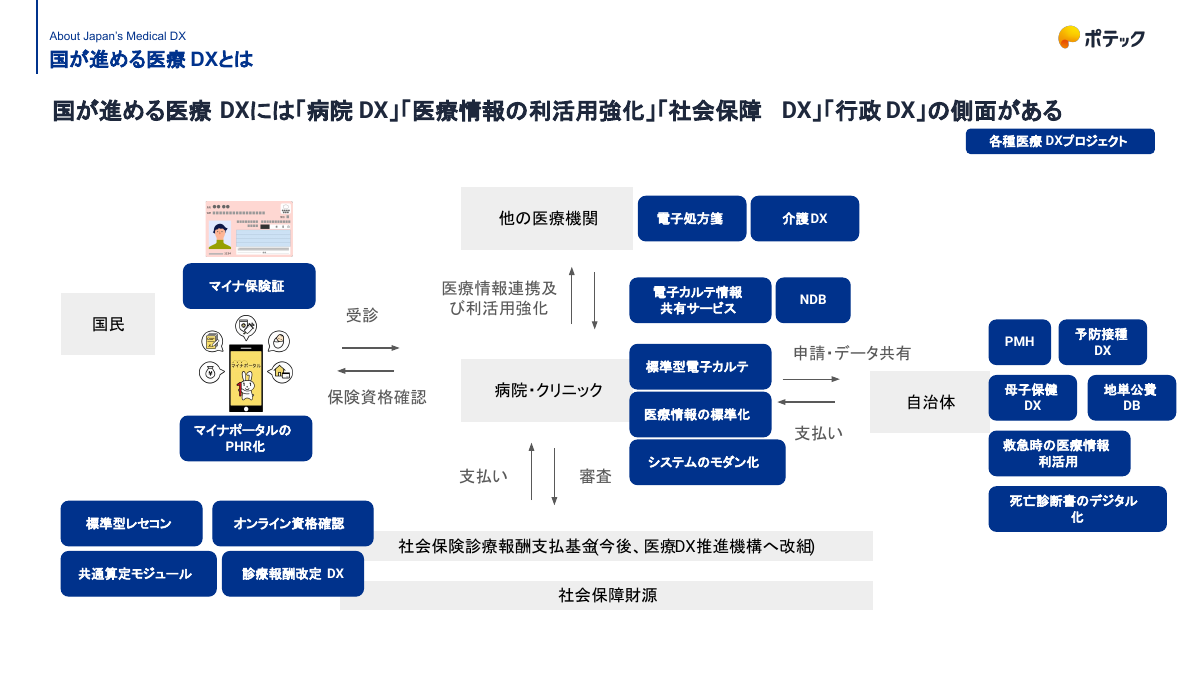
The roadmap organizes Medical DX into three pillars, but in terms of what actually changes, four faces make it easier to grasp.
| Face | Content | Main measures |
|---|---|---|
| Hospital DX | Renewing work and systems inside institutions | Standard EMR, system modernization, standardizing medical information |
| Stronger data utilization | Cross-institution linkage and secondary use | EMR Information Sharing Service, electronic prescriptions, NDB |
| Social security DX | Renewing eligibility verification, claiming, and review | Myna insurance card, online eligibility verification, common billing module, Fee Revision DX |
| Administrative DX | Digitizing procedures for municipality-run programs | PMH, Vaccine DX, Maternal and Child Health DX, local funding DB |
Of these, social security DX is the part touching "the flow of money" from an institution's viewpoint. Procedures for accessing public funds shift from paper and visual inspection to digital authentication and review.
Framing It as Authentication and Authorization
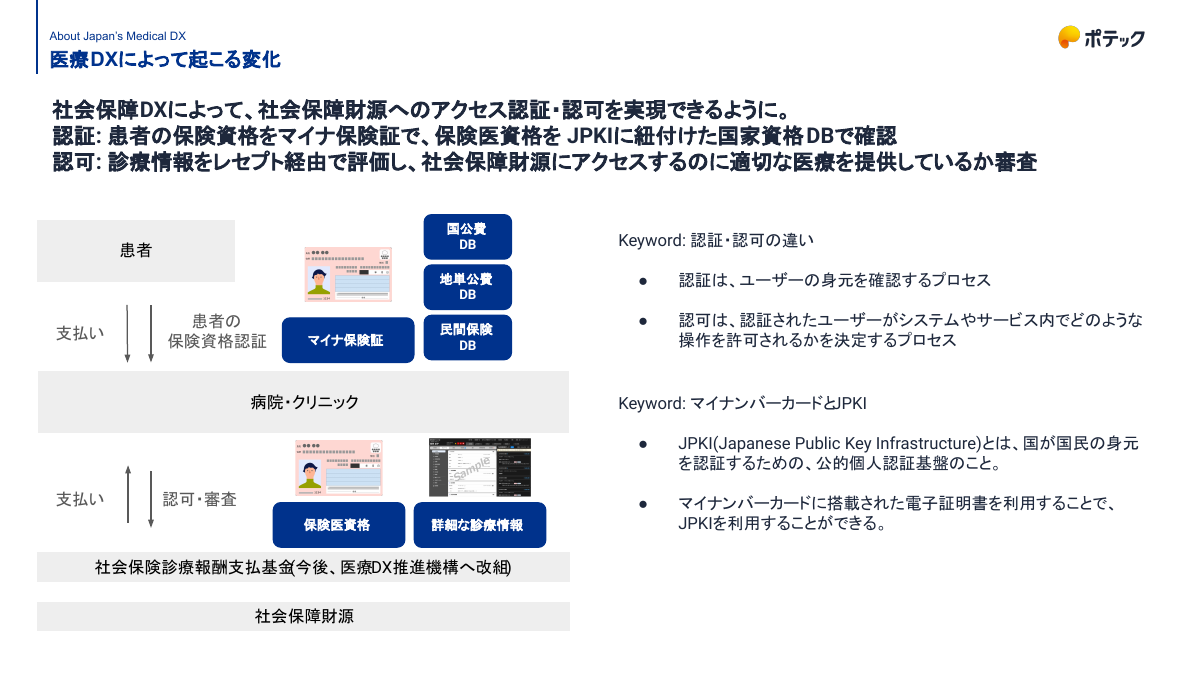
The structure maps onto the information-systems concepts of authentication and authorization.
- Authentication verifies a user's identity
- Authorization determines what an authenticated user is permitted to do
Applied to healthcare:
Authentication: Confirming Who Is Who
On the patient side, the Myna insurance card verifies insurance eligibility. Online verification reveals on the spot whether eligibility is valid, which insurer applies, and whether public funding applies. Linked with national and local public funding databases and private insurance databases, the range of services that can be provided also becomes visible immediately.
On the provider side, the direction is to verify physician credentials using JPKI (Japanese Public Key Infrastructure)—the national foundation for authenticating identity, usable via the electronic certificate on the My Number Card. Linking it to the national qualifications database makes it digitally provable that "the person who performed this act holds valid credentials."
A key point in this area is that, separately from HPKI used for physician e-signatures, JPKI is being examined as a more general-purpose foundation.
Authorization: Reviewing Whether Appropriate Care Was Delivered
Evaluating clinical information via claims to review whether the care delivered justifies access to social security funds is the authorization side. Review bodies have long performed this, but standardized EMR information and the common billing module raise the granularity and accuracy of the data available for review.
Social security DX is therefore the renewal of a mechanism that digitally establishes who did what to whom, and then judges whether public funds should be disbursed.
Fundamental Reorganization of the Payment Fund
The Payment Fund's position is also under review as the body executing social security DX. MHLW promotion-team materials have indicated:
- The Minister formulates a "Comprehensive Medical DX Securing Policy (tentative)"; the Fund formulates a "Medical DX Mid-Term Plan (tentative)"
- The Fund's name, purpose, and business provisions are reviewed to position it as the implementing body for Medical DX
- To enable unified, flexible, rapid decision-making, the current board structure is revisited, with participation by national and local stakeholders and Medical DX experts
Discussion points toward reorganizing the Fund into a Medical DX Promotion Agency. Beyond review and payment, its role expands to providing the common billing module, maintaining masters, and operating medical information infrastructure.
For institutions, this means revision handling, masters, eligibility verification, and review converge on a single counterpart.
Connection to Secondary Use
Social security DX also connects to secondary use of medical information. Points under consideration include:
- For public health and long-term care databases held by the Minister, enabling use and provision of pseudonymized information in addition to current anonymized information
- Establishing an EMR Information DB (tentative) and a municipal checkup DB (tentative), enabling use and third-party provision of anonymized and pseudonymized information
- Enabling linked analysis across these pseudonymized datasets, and with pseudonymized medical information under the Next-Generation Medical Infrastructure Act
Pathways are forming for data accumulated through care to feed back into policymaking and R&D. For institutions, this means the quality of daily chart entry increasingly affects the precision of future health policy.
A Future Question: How Granular Will Claiming Become?
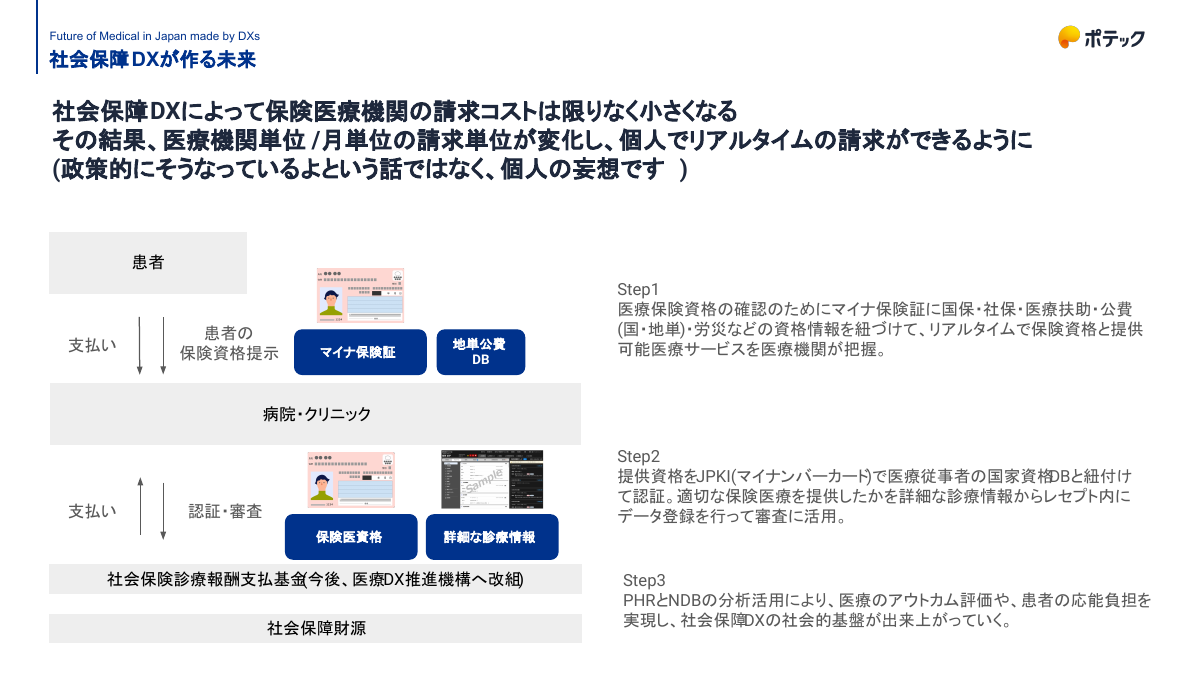
What follows is not settled policy but our CEO's personal outlook. Please note it is not a policy decision.
Where social security DX may lead is a world in which claiming costs for insured institutions shrink toward zero. As a result, today's "per-institution, per-month" claim unit could change, enabling per-person, real-time claiming.
The steps might run:
- Establishing eligibility: link national and employee insurance, medical assistance, public funding (national and local), and workers' compensation to the Myna insurance card so institutions grasp eligibility and available services in real time
- Establishing provider credentials and review: authenticate credentials against the national qualifications database via JPKI, and register detailed clinical information within claims for review of whether appropriate insured care was delivered
- Toward outcome evaluation: through analytic use of PHR and NDB, realize outcome evaluation and ability-to-pay contributions, building the social foundation of social security DX
Today's claim workflow runs on a long cycle: aggregate across a month, submit the next month, then settle through reductions and returns. Finer claim units shorten that cycle, and clerical work would be redesigned from the ground up.
What Clinics Can Do Now
Setting the future aside, three things matter practically today.
1. Operate Eligibility Verification Reliably
Online eligibility verification is the entry point. Myna insurance card utilization is built into the facility standards of the electronic clinical information coordination fee, so compliance feeds revenue directly.
2. Raise the Quality of Clinical Data Entry
Finer data for review means how charts and diagnoses are recorded affects judgments about claim validity more than before. Properly registering diagnoses and keeping them consistent with procedures performed is both a defense against returns and reductions and preparation for more sophisticated review.
3. Choose a Setup Where Revisions and Masters Are the Vendor's Job
As the Fund's role widens and the common billing module and masters are provided centrally, whether you benefit depends on the system you use. See the explainer on the common billing module.
With AI Karte
The AI-native EMR "AI Karte" links with online eligibility verification and, with its integrated rececon, handles verification, care, billing, and claim creation on one platform. Regulatory revisions are handled on the service side, and AI claim checking supports consistency between diagnoses and procedures and detection of missed billing. On data quality—an area social security DX makes more consequential—the design structures information from the point of entry.
Conclusion
Social security DX replaces the "authentication" and "authorization" of access to public funds with digital machinery. Patient eligibility via the Myna insurance card, physician credentials via JPKI and the national qualifications database, and delivered care reviewed through claims—as this structure settles, the Payment Fund expands into a Medical DX Promotion Agency and accumulated data flows back into secondary use. For clinics, three things constitute practical preparation: operating eligibility verification reliably, maintaining clinical data quality, and choosing systems that absorb regulatory change on the service side.
Through providing AI Karte, Pottech aims to be the ideal business partner for clinics—improving the working environment for physicians, nurses, and medical clerical staff, and supporting clinics in fully realizing what they want to achieve.
For more details, please feel free to contact us.
References
- Figures in this article are from a presentation by Takuma Arimura, CEO of Pottech Inc.: "Can Medical DX Change Provider Management? The Standard EMR and the Future of Medical DX and Hospital Management" (June 19, 2025)
- Roadmap for Promoting Medical DX (Medical DX Promotion Headquarters)
- On Online Eligibility Verification and Using the My Number Card as an Insurance Certificate (MHLW)