
Among Medical DX measures, PMH (Public Medical Hub) is one of the least known. Yet for clinics that routinely handle vaccinations, infant health checkups, and medical expense subsidies—pediatrics and obstetrics/gynecology above all—it is the measure most likely to change front-desk work directly. This article organizes what PMH is, what it connects, and how frontline operations change.
Disclaimer: This article is general information. Covered areas, participating municipalities, and operational details may expand or change. In practice, always confirm the latest primary sources (the Digital Agency, MHLW, and your municipality's published materials).
For the overall map of Medical DX, see What Is Medical DX? The Government Roadmap and Its Three Pillars.
What PMH Is
PMH (Public Medical Hub) is a linkage platform built by the Digital Agency for exchanging information between municipalities and medical institutions.
Medical DX measures to date have mainly connected institutions to one another (electronic prescriptions, the EMR Information Sharing Service). PMH fills a different gap: it connects the information municipalities hold with the information medical institutions hold.
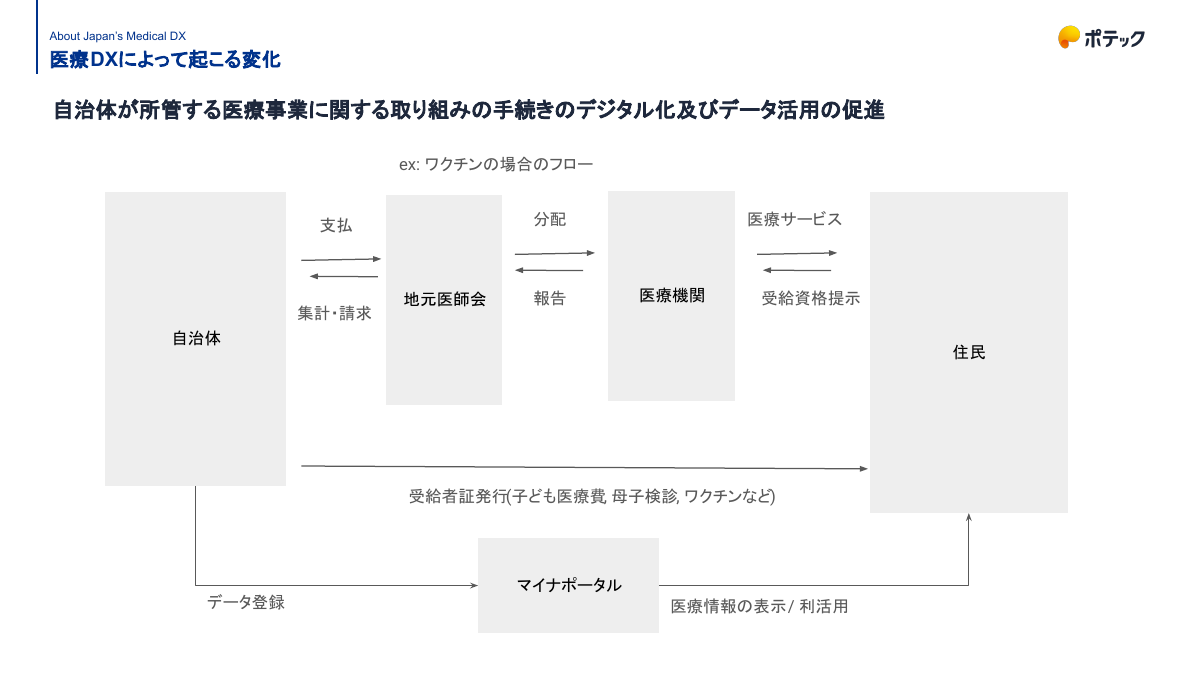
Municipalities hold information such as vaccination eligibility, infant checkup records, and entitlement to medical expense subsidies. Traditionally this reached institutions only when patients brought paper notices or benefit certificates. PMH digitizes that path.
Areas Covered
What PMH handles differs in character from institution-to-institution sharing.
| Area | Examples |
|---|---|
| Vaccinations | Eligibility confirmation, pre-vaccination questionnaires, vaccination records |
| Maternal and child health | Infant checkup and prenatal checkup records |
| Medical expense subsidies (publicly funded care) | Municipality-specific subsidies, public funding eligibility checks |
| Long-term care | Linkage of care information |
What they share is that the municipality is the body implementing the program.
For municipality-run programs, issuing benefit certificates, distributing to and reporting from institutions, and aggregation and claiming have all run on paper and manual work. PMH replaces that flow with Mynaportal and data linkage.
What Changes
Eligibility Checks at the Front Desk
The clearest change is that paper checks such as benefit certificates become electronic. For programs like infant medical expense subsidies—where formats and operations differ by municipality—front-desk verification was laborious and error-prone. Being able to verify eligibility with a My Number Card lowers that burden.
The effect is greatest for patients who have moved in from another municipality, or cases like returning home to give birth where the residence and the place of care differ, since verification itself was previously difficult.
Digitizing Pre-Vaccination Questionnaires
Patients will be able to complete vaccination questionnaires in advance via Mynaportal. Waiting time to fill out forms at the counter falls, and checking for omissions becomes more efficient. For details, see the explainer on Vaccine DX.
Sharing Checkup Results
Results of infant and prenatal checkups become viewable by the individual through Mynaportal and shareable between municipalities. The long-standing problem of records not carrying over when families move begins to be resolved. For details, see the explainer on Maternal and Child Health DX.
Status of Early Rollout
PMH does not start nationwide at once; it expands in stages from participating municipalities.
| Period | Content |
|---|---|
| FY2023 | Early rollout begins; 16 municipalities and 87 institutions selected by open call |
| FY2024–FY2025 | Covered areas and participating municipalities expand |
| As of April 2026 | More than 100 municipalities participating |
Early rollout has proceeded with verification split across three areas: medical expense subsidies, vaccinations, and maternal and child health.
This "spreads municipality by municipality" pattern matters to institutions, because even if your clinic wants to participate, you cannot use it unless your local municipality has joined. Conversely, once a municipality joins, local institutions will be asked to support it.
What Clinics Can Do Now
1. Check Your Municipality's Participation
First, check whether the municipality where your clinic is located—and those where your main patients live—have joined PMH. Timing differs by municipality, so consult their published information.
2. Relevant Specialties Should Gather Information Early
Pediatrics, obstetrics/gynecology, and internal medicine practices handling many vaccinations will feel the greatest operational impact. The more vaccinations and infant checkups you handle, the more advance preparation pays off.
3. Confirm Your System Vendor's Approach
Digitizing questionnaires and linking eligibility checks may require support on the EMR/rececon side. Confirm your vendor's plans.
4. Assume Paper Operations Continue Alongside
Even after digitization, paper questionnaires and benefit certificates will coexist for some time. Practically, design a reception flow that handles both electronic and paper.
Its Place in Medical DX Overall
PMH forms part of the National Medical Information Platform (pillar ① of Medical DX). If mechanisms connecting institutions are the "horizontal" links, PMH is the "vertical" link between municipalities and institutions.
Connecting the information government holds with what institutions hold means an individual's health information—including public health domains such as vaccinations and checkups—can be handled as one continuous flow. That is what PMH aims for.
With AI Karte
The AI-native EMR "AI Karte" includes functions for daily pediatric and obstetric work such as vaccination management and infant checkup records. We are also examining our approach to Medical DX data linkage in light of how implementation progresses on the regulatory side. We welcome consultations on adoption tailored to each specialty's workflow.
Conclusion
PMH is a linkage platform connecting municipalities and medical institutions rather than institutions to one another. It covers areas long handled through paper notices and benefit certificates—vaccinations, maternal and child health, and medical expense subsidies—so the impact on front-desk work is not small. Because it expands from participating municipalities, the starting point is checking the situation in your own area. For pediatrics and obstetrics/gynecology in particular, gathering information early translates into a lighter operational load.
Through providing AI Karte, Pottech aims to be the ideal business partner for clinics—improving the working environment for physicians, nurses, and medical clerical staff, and supporting clinics in fully realizing what they want to achieve.
For more details, please feel free to contact us.