
"Apparently the government is building an EMR." "Won't EMRs be mandatory by 2030?" Fragmentary claims like these tend to run ahead of the facts about the standard EMR. This article organizes what the standard EMR is, why the government is developing it, and how far it has progressed—then sets out how to think about whether your clinic should wait for it or adopt a commercial product.
Disclaimer: This article is general information. Development status, provision timing, and functional scope may change. In practice, always confirm the latest primary sources (official materials from the Digital Agency and MHLW, and materials from review meetings and working groups).
For the overall map of Medical DX, see What Is Medical DX? The Government Roadmap and Its Three Pillars.
What the Standard EMR Is
The standard EMR is an electronic medical record developed by the government (the Digital Agency) and provided to medical institutions. It is intended to be one option alongside commercial vendors' products.
It falls under pillar ② of Medical DX, "standardizing EMR information," and development has two main aims:
- Closing the gap of institutions without an EMR: a meaningful number of institutions, mainly smaller clinics, still have no EMR
- Circulating data compliant with standards: spreading EMRs that support the standards underlying information sharing (such as HL7 FHIR) from the outset
In other words, rather than a standalone product, the standard EMR is better understood as an on-ramp for feeding data into the National Medical Information Platform.
Why the Government Is Building an EMR
Information-sharing mechanisms such as the EMR Information Sharing Service and PMH cannot function unless data exists electronically at the institution in the first place. As long as paper-chart institutions remain, nationwide sharing will have blank spots.
Meanwhile, institutions without an EMR face cost burdens, the effort of changing operations, and, at small scale, difficulty recouping the investment. The background is a judgment that the government should directly address the segment where market forces alone will not drive adoption.
The Diffusion Picture
Per an MHLW survey published in January 2025, EMR diffusion as of FY2023 stood as follows.
| Category | Adoption |
|---|---|
| General hospitals (all) | 65.6% |
| 400+ beds | 93.7% |
| 200–399 beds | 79.2% |
| Under 200 beds | 59.0% |
| General clinics | 55.0% |
Large hospitals are essentially done, while small and mid-sized hospitals under 200 beds and general clinics sit only just above half. That is the standard EMR's main battleground.
The Government Target and Current Status
The roadmap states, regarding the standard EMR, the aim of "adoption at essentially all medical institutions by 2030 at the latest." "Adoption" here is naturally read as covering standards-compliant EMRs generally, not the standard EMR alone.
Development has progressed as follows:
| Period | Content |
|---|---|
| FY2024 | Development begins at the Digital Agency |
| March 2025 | Alpha-version model project launched (targeting institutions without an EMR) |
| Around summer 2025 | Second wave of the model project |
| During FY2026 | Completion is targeted |
The alpha model project has verified, in the field, linkage with the National Medical Information Platform—such as sharing referral letters and prescription information. As of the first half of 2026 it had not yet reached full provision, and the concrete start date remains fluid.
Who It Targets
This is the most misunderstood point. The standard EMR primarily targets medical clinics that have not adopted an EMR. It is not intended to push institutions already using one to switch.
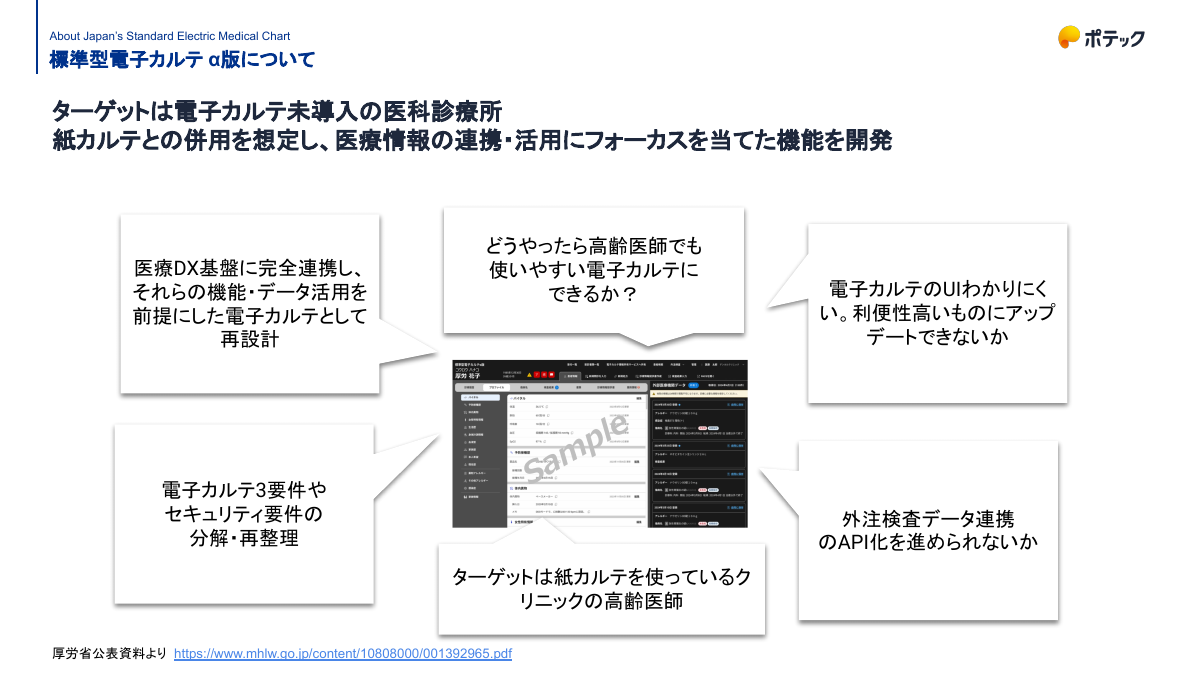
Distinctively, it assumes coexistence with paper charts. The target is older physicians at paper-based clinics, and the design centers less on "making them stop using paper" than on "creating an on-ramp to data linkage and utilization." Development wrestled with questions such as: can it be redesigned as an EMR that fully integrates with Medical DX infrastructure; can it be made usable by older physicians; can EMR UI be updated to something genuinely convenient; can the three EMR requirements and security requirements be decomposed and reorganized; can external lab data linkage be moved to APIs.
Expect its functional scope to differ from commercial products—it does not broadly cover specialty-specific functions or peripheral areas such as booking, questionnaires, and analytics.
Information Design
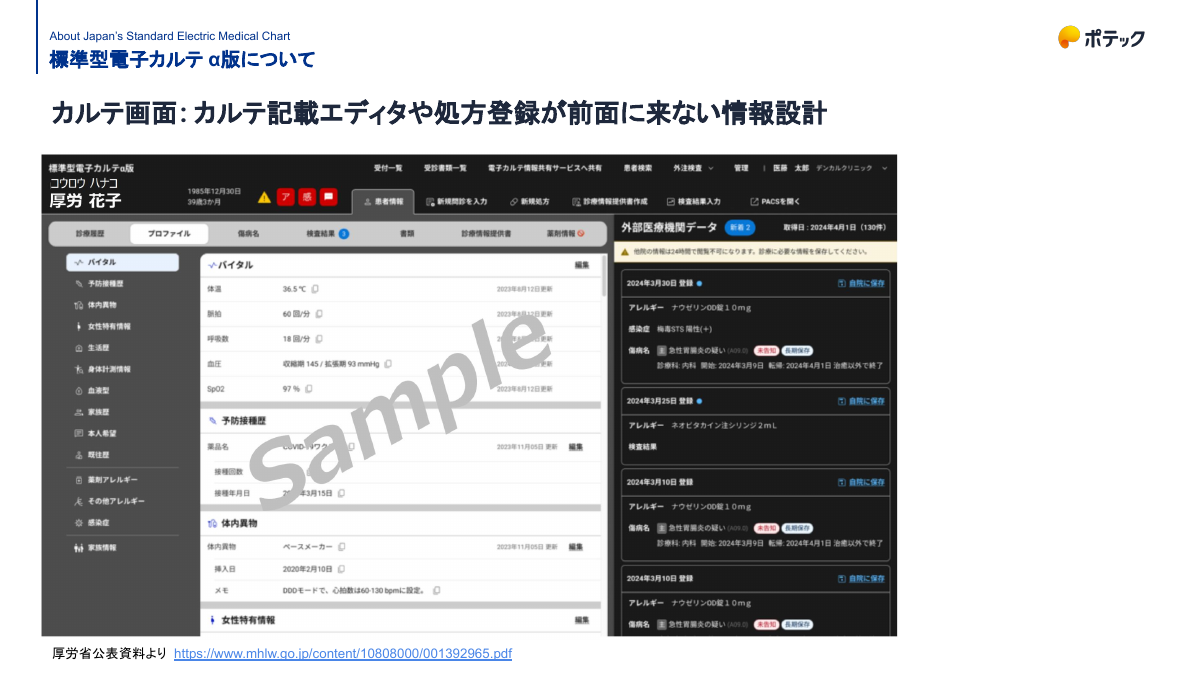
The alpha's chart screen is designed so that the note editor and prescription entry are not front and center. At the center sits the patient profile—vitals, vaccination history, implants, women's health information, history, drug allergies, infectious diseases—with data retrieved from other institutions displayed persistently on the right.
This inverts the conventional premise. Where a traditional EMR is "a tool for writing," the alpha is designed as "a tool for understanding the patient."
API Linkage for External Lab Data
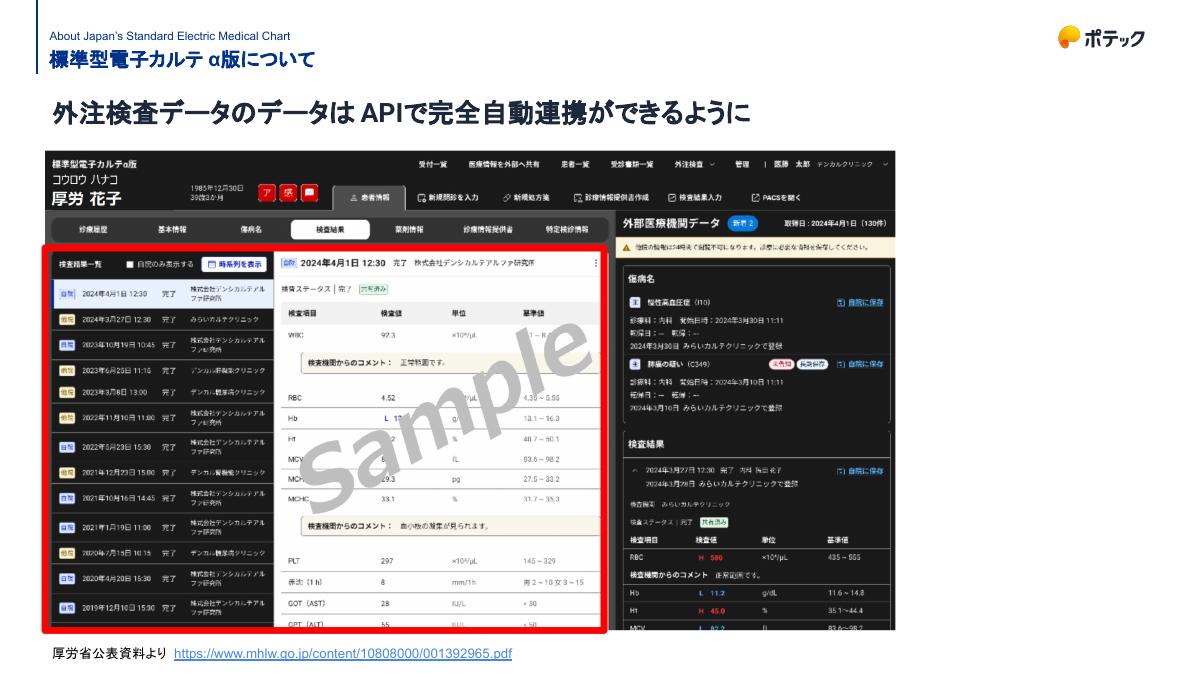
Another feature is fully automatic API linkage of external lab data, with time-series comparison, part of which becomes viewable via Mynaportal through the EMR Information Sharing Service. A design that does not presume paper, fax, or manual entry benefits smaller institutions most.
Standard Requirements Also Shape Migration from an Existing EMR
The same EMR information standardization behind the standard EMR directly affects how easily data migrates when switching from an existing chart. For migration methods that assume HL7 FHIR, SS-MIX2, and standard codes—and the limitations that remain—see EMR Data Migration Aligned with Standard Requirements.
How to Decide Whether to Wait
For clinics without an EMR, there are two realistic options. Here are rough criteria.
Cases where waiting for the standard EMR is reasonable
- Care is straightforward, centered on charting and prescribing
- You barely use peripheral functions such as booking, questionnaires, or imaging integration
- Minimizing initial and running costs is the top priority
- You opened recently and can still operate on paper at your current scale
Cases where a commercial EMR is the better fit
- You need specialty-specific functions (ophthalmic device integration, orthopedic PACS integration, pediatric growth curves, and so on)
- You want to streamline peripheral work too—booking, web questionnaires, online consultations
- You want an integrated rececon so clerical work flows end to end
- You want to reduce daily input load through voice input or AI-assisted documentation
- You would rather solve today's operational problems than wait for something without a fixed date
The last point deserves emphasis. The timing of full provision is not firmly fixed. Choosing to "wait" is also choosing to accept the inefficiency in the meantime, and should be weighed as such.
The Japan Medical Association's Stance
The JMA Medical IT Committee's report "The Medical Association's Role in Appropriately Advancing Medical DX" (June 2024) is a reference point. It holds that fully replacing paper charts with electronic ones is impossible and should not be the goal, and states that "even if paper charts continue to be used, we should aim for a Medical DX from which those users can still benefit."
This aligns with the standard EMR being designed for coexistence with paper: the goal is not the adoption rate itself but delivering the benefits of data linkage to clinical settings and patients.
Will EMRs Become Mandatory?
You may see the phrase "EMRs become mandatory in 2030," but the roadmap's wording is a target—"aim for adoption at essentially all medical institutions"—not an obligation backed by penalties.
That said, substantive steering is under way from the fee schedule side. Additions such as the electronic clinical information coordination fee build support for online eligibility verification, electronic prescriptions, and the EMR Information Sharing Service into facility standards, and requirements that cannot be met without an EMR keep increasing. The closer reading is: not mandatory, but the opportunity cost of not complying keeps growing.
With AI Karte
The AI-native EMR "AI Karte" presupposes support for standards while providing, in a single service, automatic chart generation via voice input, clerical work through an integrated rececon, AI claim checking, and practice analytics. Where the standard EMR mainly addresses "closing the no-EMR gap," AI Karte aims to raise the efficiency of daily clinical and clerical work itself. We also welcome consultations on adoption tailored to each specialty's workflow.
Conclusion
The standard EMR is a measure to fill in the foundation for nationwide information sharing, primarily targeting institutions without an EMR. It is not something institutions already using an EMR would consider switching to, nor is its functional scope directly comparable with commercial products. For clinics without an EMR it is a realistic option, but the decision should rest on your own clinical content and operational challenges, bearing in mind that the provision date is not fixed and the functionality is limited.
Through providing AI Karte, Pottech aims to be the ideal business partner for clinics—improving the working environment for physicians, nurses, and medical clerical staff, and supporting clinics in fully realizing what they want to achieve.
For more details, please feel free to contact us.