
Following the individual measures of Medical DX eventually leads to one question: does any of this actually improve our economics? Adopting online eligibility verification, supporting electronic prescriptions, billing the additions—all necessary, but none of it changes the economic structure itself. This article maps the environmental changes surrounding provider economics across the next decade, then asks where Medical DX actually bites.
Disclaimer: This article is general information and does not recommend any specific management decision. Figures are as of their source date. Always confirm the latest primary sources in practice.
For the overall map of Medical DX, see What Is Medical DX? The Government Roadmap and Its Three Pillars.
Premise: Provider Revenue Structure Is Extremely Simple
According to Chuikyo's survey of healthcare economics, clinics without inpatient revenue derive over 90% of revenue from outpatient care. At hospitals, inpatient and outpatient revenue combined exceed 90%, with everything else marginal.
In other words, provider economics today depend almost entirely on a single price list: the fee schedule. You cannot set your own prices; unit prices are fixed by revisions, and volume is largely determined by demographics and location. The room for management effort is structurally narrow.
The result: surveys by hospital associations found that 74.9% of hospitals ran deficits in FY2023—over 70% of roughly 8,000 hospitals.
Given this structure, the levers reduce to two: optimize within the fee schedule, or build revenue outside it.
Environmental Change Over the Next Decade
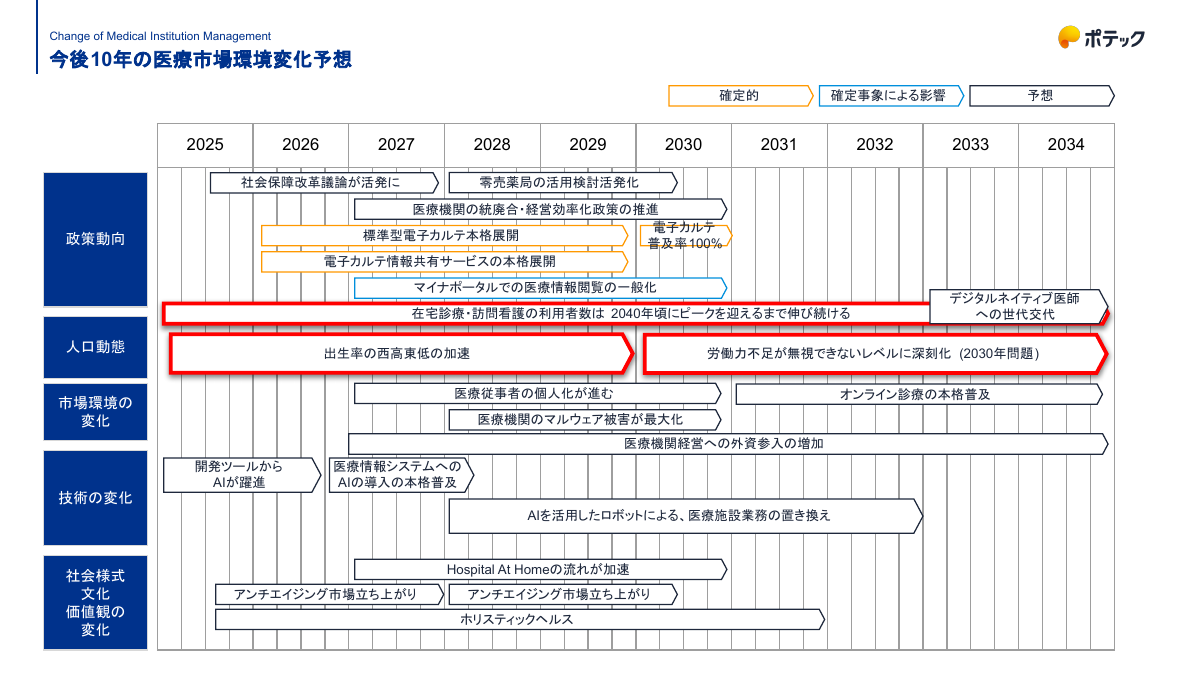
It helps to separate changes into three layers: the certain, the consequent, and the speculative. Viewed across six axes, the medium- to long-term macro environment looks as follows.
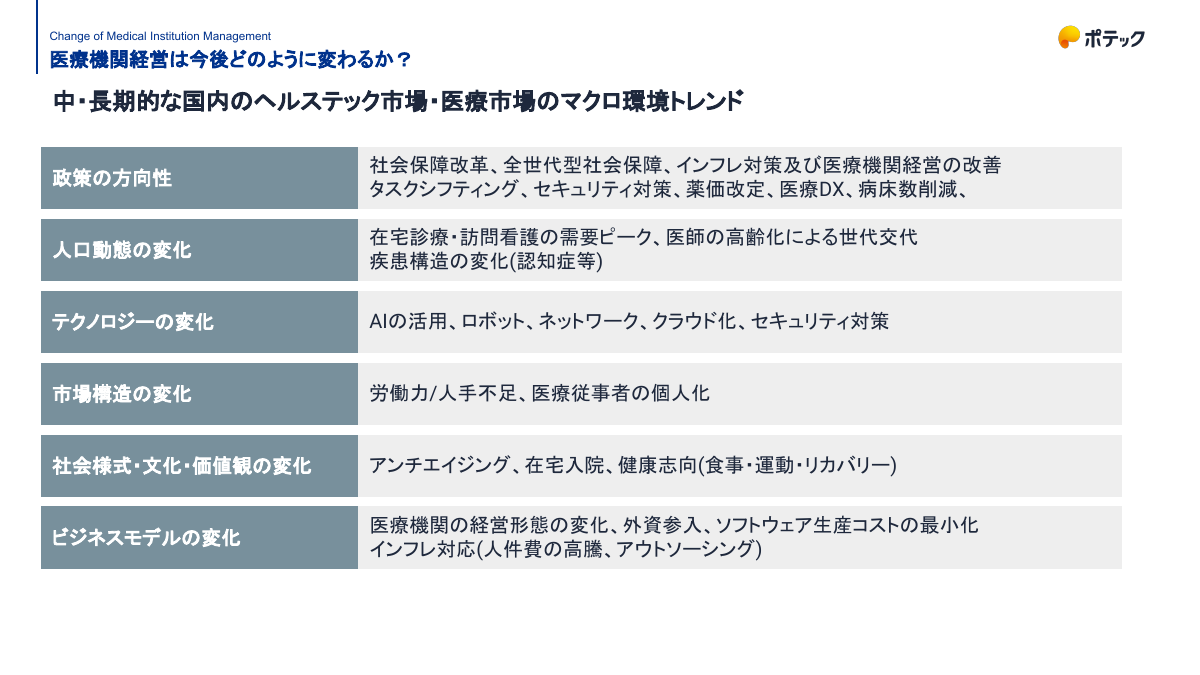
Policy
- Full rollout of the standard EMR and the EMR Information Sharing Service from FY2026 onward
- The roadmap targets EMR adoption at essentially all institutions by 2030
- Viewing medical information via Mynaportal becomes commonplace
- Consolidation policies and bed-count reduction advance
Demographics
This is the highest-confidence change.
- Home care and visiting nursing keep growing until peaking around 2040. MHLW estimates that home-visit care peaks after 2040 in 305 secondary medical areas, and visiting nursing in 198
- From 2025, the late-elderly share of home-visit patients is projected to exceed 90%
- Generational turnover as physicians age. The average age of clinic physicians keeps rising, and demand for digital products is tied directly to this turnover
Labor: The 2030 Problem
Persol Research estimates that against 13.67 million workers needed in health and welfare in 2030, the projected workforce is 11.80 million—and the projected stable workforce, accounting for early attrition, only 8.85 million. That implies a shortfall of roughly 30% (4.82 million people).
No recruiting effort closes a gap that size. Management must be designed on the premise that you either reduce the work itself or have something other than people do it.
Technology and Market Structure
- AI adoption in medical information systems becomes mainstream; general tasks (cleaning, laundry, meal service, bed-making) may shift to robots
- Healthcare workers individualize (work patterns that do not presume full-time employment)
- Malware damage to institutions peaks
- Online care becomes widespread; foreign capital enters provider management
Lever 1: Diversify Revenue
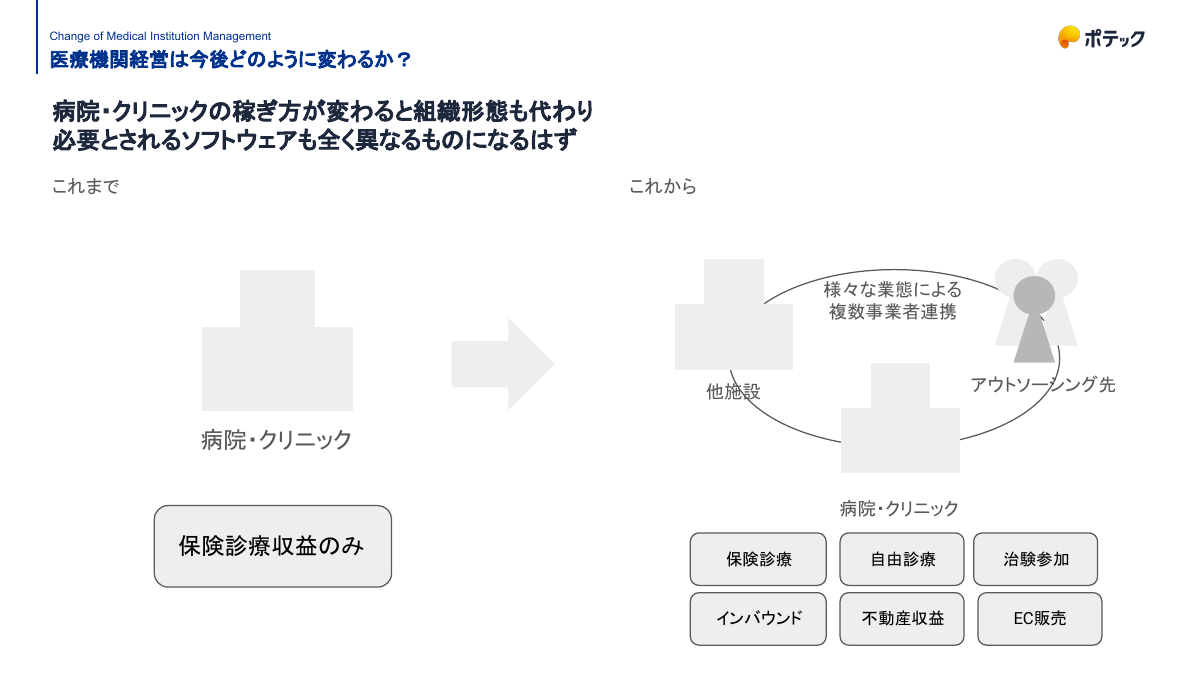
Escaping fee-schedule dependence means adding revenue sources. More institutions now combine insured care with self-pay care, clinical trial participation, inbound patients, real estate income, and e-commerce.
What matters here: when how you earn changes, organizational form changes too—and the software you need becomes something entirely different. An EMR/rececon built only for insured care cannot handle self-pay pricing, retail inventory, trial case management, or coordination across multiple operators.
If you are considering diversification, widen your system criteria from "can it bill insured care correctly" to "can it handle non-insured operations on the same platform."
Lever 2: Decompose Management Functions
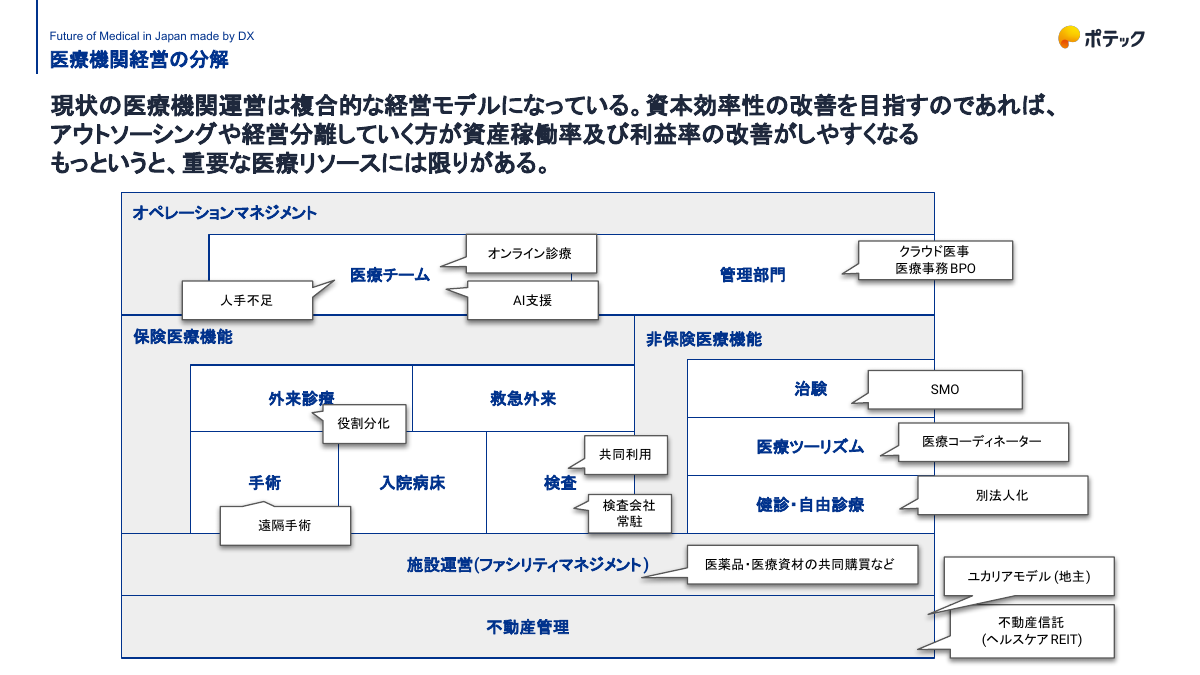
Provider operations today fuse operations management, insured care, non-insured care, facility operations, and real estate into one composite model. To improve capital efficiency, decomposing these—via outsourcing or separating operations—makes asset utilization and margins easier to improve.
| Function | Direction of decomposition |
|---|---|
| Administration | Cloud clerical services, medical clerical BPO |
| Care team | Online care, AI-assisted labor savings |
| Testing | Resident testing companies, shared equipment |
| Clinical trials | Use of SMOs |
| Checkups / self-pay | Separate legal entity |
| Facility operations | Joint purchasing of drugs and supplies |
| Real estate | Real estate trusts (healthcare REITs), separating ownership from operation |
Given that critical clinical resources are finite, carving out functions that physicians and nurses need not perform is rational. Medical DX makes that carve-out technically possible: external BPO providers seeing the same data, and cloud access enabling work from outside the facility, are preconditions for decomposition.
Lever 3: Do Not Swap Systems Without Changing the Organization
This is the most overlooked point.
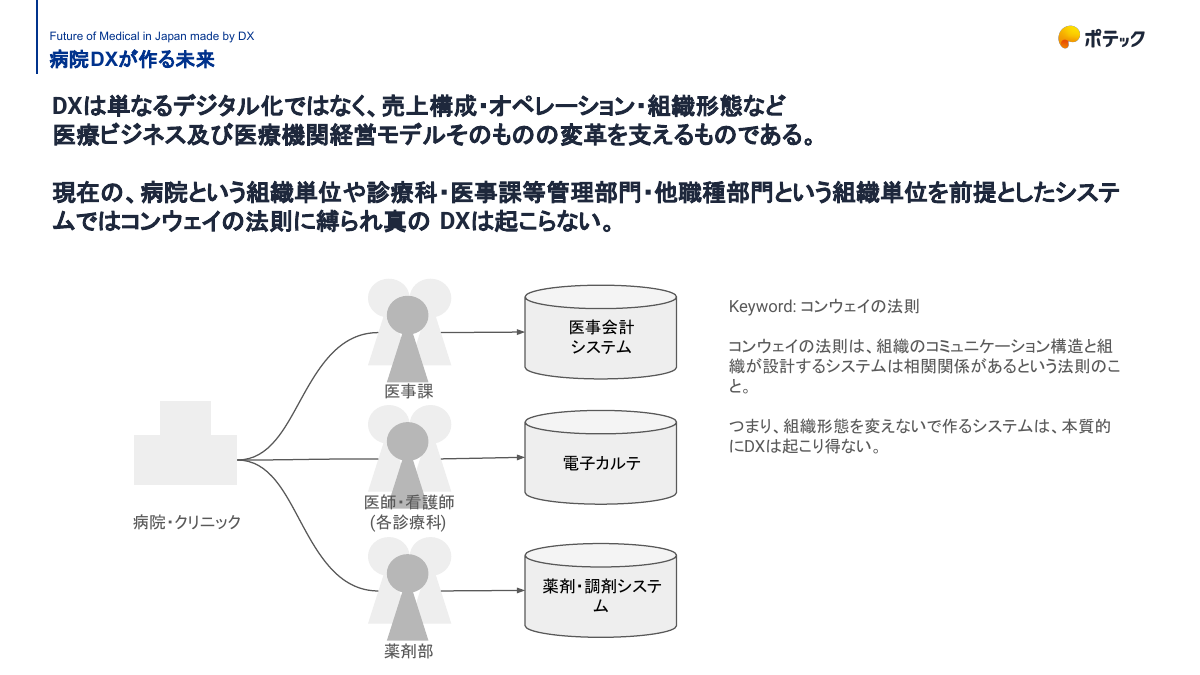
DX is not mere digitization; it supports transformation of the business and management model itself—revenue mix, operations, organizational form. Yet hospital systems today are split along existing organizational lines: the billing department has a billing system, physicians and nurses have an EMR, pharmacy has a dispensing system.
Software engineering has an empirical rule, Conway's law: the structure of a system mirrors the communication structure of the organization that designs it. Inverted, that means a system built without changing organizational form cannot produce genuine DX.
Whether you can question how work itself is held—before or alongside system adoption—is the dividing line. Projects that "systematize the current workflow as is" fail to deliver expected effects for exactly this reason.
Where Medical DX Actually Bites
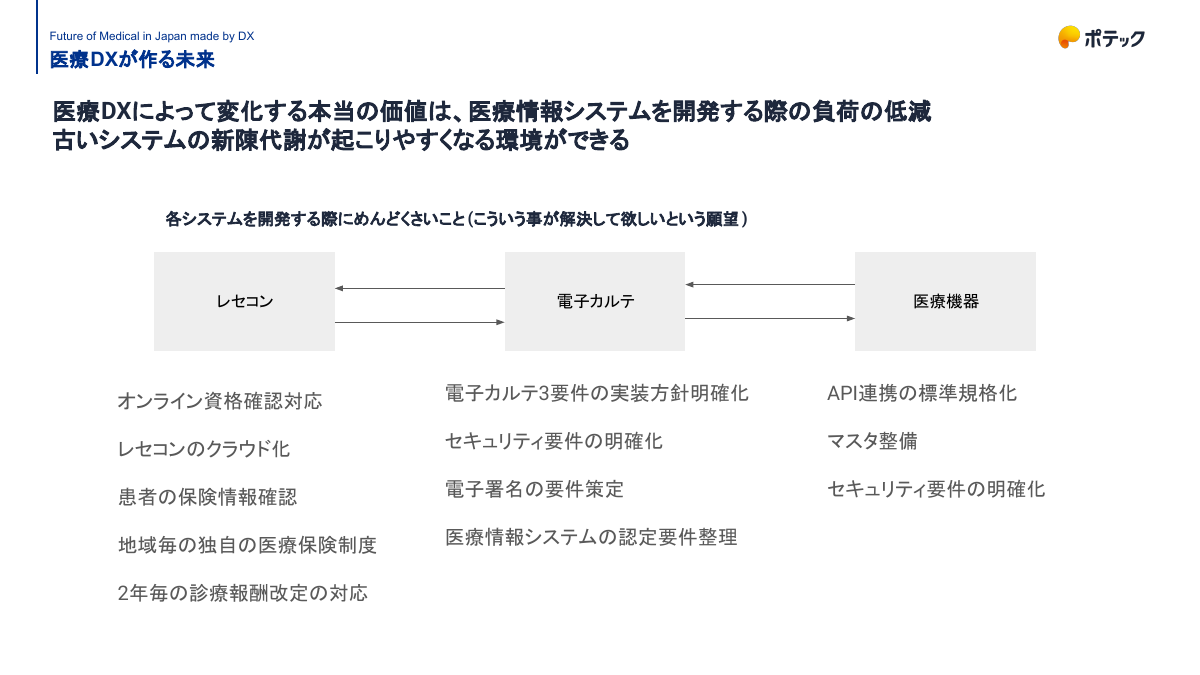
The value national Medical DX brings to provider economics is not only satisfying addition requirements. Over the medium to long term, what matters more is that the burden of developing medical information systems falls, creating an environment where old systems turn over more readily.
Vendors of rececons, EMRs, and medical devices have each carried burdens:
- Rececon: online eligibility verification, cloud migration, insurance verification, region-specific subsidy programs, biennial fee revisions
- EMR: clarifying implementation of the three EMR requirements, security requirements, e-signature requirements, certification requirements
- Medical devices: standardizing API integration, master data, clarifying security requirements
The common billing module, common masters and codes, and standards development lower these burdens industry-wide. Lower barriers invite new entrants and put renewal pressure on incumbents. For institutions, that means more product choice and lower switching costs.
Conversely, staying on a product whose vendor does not ride this shift means relatively rising costs. See the explainer on Fee Revision DX.
A Realistic Conclusion for Clinics
Hospitals and clinics have different ranges of action. At clinic scale, three things are realistic:
- Execute fee-linked compliance reliably — items like the electronic clinical information coordination fee, where compliance feeds billing, come first
- Shift to operations that do not presume manpower — the 2030 shortage will not be filled by hiring. Investments that cut work volume itself—voice input, AI questionnaires, self-checkout, automated claim review—rise in priority
- Widen system criteria from today's operations to those five years out — factor in possible revenue-mix change, standards support, and the cost structure of handling revisions
With AI Karte
The AI-native EMR "AI Karte" provides automatic chart generation via voice input, AI claim checking, and practice analytics on a single cloud platform with an integrated rececon. It is designed to support the shift to operations that do not presume manpower, while absorbing regulatory change on the service side. We welcome consultations tailored to your clinic's scale, specialty, and revenue mix.
Conclusion
Provider revenue depends heavily on the fee schedule, and roughly 75% of hospitals run deficits. Over the next decade, expanding home care demand, the 2030 labor shortage, practical AI and robotics, and universal EMR adoption will compound. Medical DX bites not through billing additions but in three places: making revenue diversification technically possible, enabling decomposition of management functions, and accelerating system turnover to improve choice and cost. None of the three is achievable without questioning how the organization itself is held.
Through providing AI Karte, Pottech aims to be the ideal business partner for clinics—improving the working environment for physicians, nurses, and medical clerical staff, and supporting clinics in fully realizing what they want to achieve.
For more details, please feel free to contact us.
References
- Figures in this article are from a presentation by Takuma Arimura, CEO of Pottech Inc.: "Can Medical DX Change Provider Management? The Standard EMR and the Future of Medical DX and Hospital Management" (June 19, 2025)
- Roadmap for Promoting Medical DX (Medical DX Promotion Headquarters)
- Materials on home care demand estimates (MHLW)
- Labor estimates from Persol Research Institute, "Future Estimates of the Labor Market 2030"